A Night Beneath the Burning Sky

 🔥 “A Night Beneath the Burning Sky”

In the summer of 1925, the oil fields of Moreni, Romania, became the stage for one of the most dramatic industrial disasters of the early 20th century — a fiery eruption that threatened to consume an entire valley, yet paradoxically prevented an even greater catastrophe.

⚙️ The Inferno at Pleașa-Moreni

Through the courtesy of Bucharest lawyer Ștefan Iosif, a correspondent from Gazeta Transilvaniei visited the blazing oil well at Pleașa-Moreni. The journey from Brașov through the wooded valleys and steep hills of Filipesti led to a surreal spectacle: thousands of electric lamps illuminating the valley like a city seen from an airplane, and at its center, a colossal red star — the burning well itself.

The scene was both magnificent and terrifying. Flames soared up to 40 meters high, scorching orchards, vineyards, and homes. The heat was so intense that fruit trees carbonized at a hundred meters’ distance. The well had become a man-made volcano, roaring and shaking the earth.

🧯 The Battle to Extinguish the Blaze

Two American engineers, clad in asbestos suits, approached the inferno to within fifteen meters — only to retreat drenched in sweat. Workers dug tunnels beneath the well to reach the erupting column of oil, but early miscalculations caused collapses and tragic losses. The first attempt cost three lives.

The tunnel entrance beneath the well on the 5th of August 1925

The second tunnel, wider and deeper, aimed to crush the iron column rather than drill through it — a method suggested weeks earlier by Iosif himself. This approach finally began to tame the eruption, though the delay had already cost millions.

💰 A National Loss

The fire consumed hundreds of millions in oil wealth, with an estimated 150 railcars of high-quality crude lost daily. The state suffered not only from the destruction of resources but also from lost taxes and economic paralysis. The article questioned why the Romanian government had left the operation entirely to the private Romano-American Oil Company, whose efforts seemed slow and secretive.

Could the disaster have been mitigated with greater state intervention — with soldiers and laborers mobilized to dig and contain the blaze? The author believed so.

🌬️ The Fire That Prevented a Greater Disaster

Ironically, the ignition of the well may have saved Moreni. Had the gases erupted without catching fire, they would have spread across the valley, turning every spark into a massive explosion. The initial blaze confined the gases, preventing a catastrophe that could have wiped out entire neighborhoods.

🏭 Lessons from the Flames

The Moreni fire exposed the fragility of Romania’s booming oil industry — its reliance on foreign expertise, its lack of emergency planning, and its dangerous complacency. It was a wake-up call for the ministries of Finance and Industry: progress demands vigilance.

Wrath From the Deep

 🌋 Wrath From the Deep

🛢️ A Routine Operation Turns Catastrophic

On 28 Mai 1931, at the drilling point known as Dealul Crucii near Gura Ocniței, the newly spudded well 14 PH Viforata — drilled earlier that year to a depth of 985 meters — erupted with a violence that stunned even the most seasoned oil workers of the Prahova region.

What began as a sudden burst of gas escalated within moments into a full-scale blowout. The entire drilling string was thrown out of the wellbore, followed by a torrent of gas, mud, and crude oil that blanketed the surrounding hillsides.

🌬️ Gas Clouds, Deafening Roars, and a Region in Panic

As the eruption intensified, the well began ejecting not only oil and gas but also tools and debris. Winds carried the gas over long distances, creating a suffocating atmosphere across the valley. The roar of the eruption was so powerful that, even at 300 meters, human voices were drowned out.

Residents across a radius of 5–6 kilometers awoke to find their gardens, homes, and forests coated in a black sheen of oil. Fear spread quickly — memories of the catastrophic Moreni fire two years earlier were still fresh.

🚨 Emergency Measures: A Race Against a Potential Inferno

Authorities reacted with urgency:

  • Mining inspectors from Gura Ocniței rushed to the site.
  • Fire brigades were stationed around the clock.
  • Eighty soldiers from Târgoviște and numerous gendarmes secured the perimeter.
  • Nearby wells operated by “Unirea” drastically reduced their output to minimize ignition risks.

Despite these efforts, the eruption only grew more violent. The pressure increased relentlessly, and the well began producing more than 200 wagons of oil per day — an astonishing, uncontrollable flow.

🏚️ Collapse of the Well Structure

The force of the eruption eventually eroded the casing completely. The entire derrick of well 14 PH Viforata collapsed, crushing machinery beneath it. Oil shot skyward to heights exceeding 170 meters, forming a dark, towering plume visible from miles away.

Two hundred workers labored continuously to channel the oil into makeshift reservoirs, but the volume was overwhelming. The financial damage to local landowners reached into the tens of millions.

💧 The Final Battle: Extinguishing the Monster

After days of chaos, specialists implemented a drastic but effective solution: flooding the old borehole with water to smother the eruption. The method succeeded, and the Ministry of Industry and Commerce announced the extinguishing of the well in a brief, understated communiqué.

Behind that short statement lay one of the most dramatic industrial emergencies in Romanian oil history — a moment when geology, technology, and human determination collided in spectacular fashion.

AI colorized Moreni oilfield photo

AI colorized Moreni oilfield photo
 

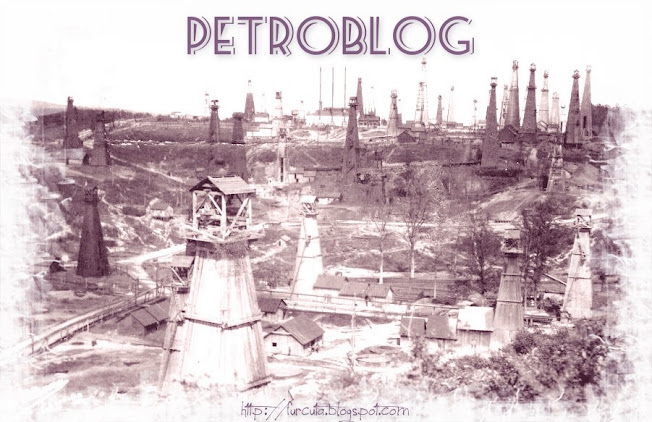
Oil wells with wooden derricks on Tuicani Plateau

Oil wells with wooden derricks on Tuicani Plateau.
Moreni, interwar.